
Blog
Redefining Accounting for a Sustainable Future
Why Modern Businesses Need More Than Just Numbers?
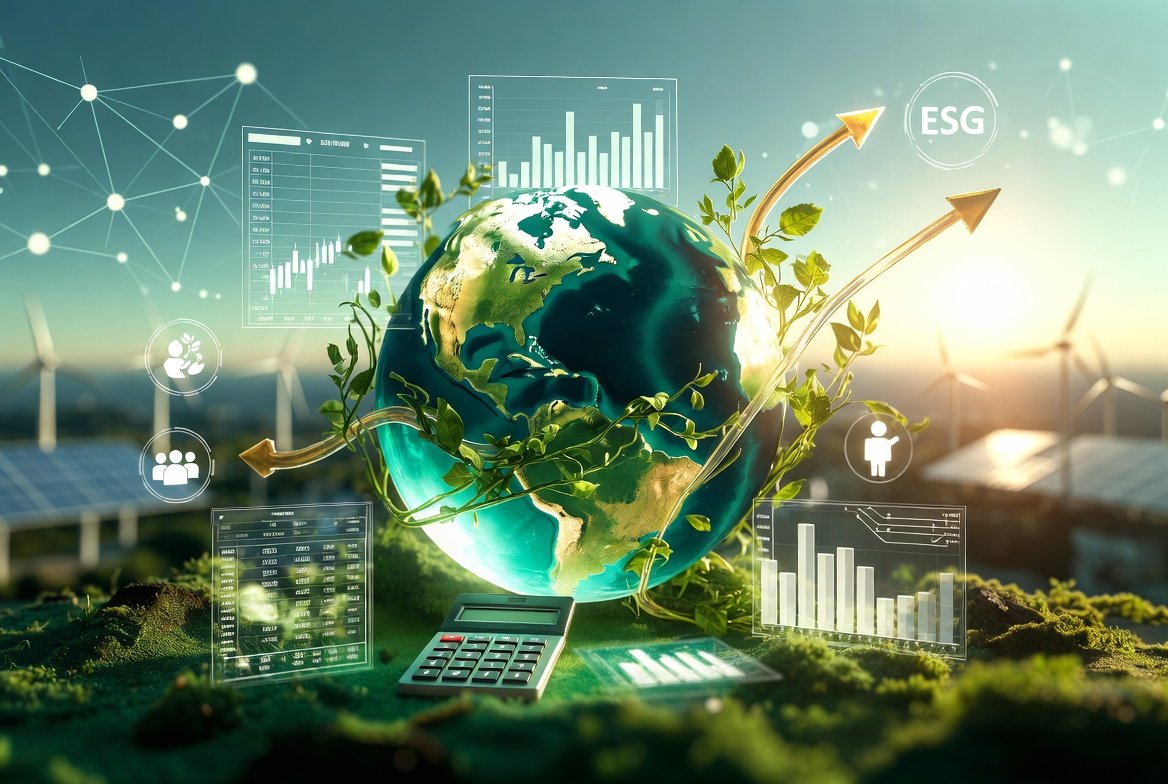
For decades, accounting has been seen as one of the most essential yet routine functions in business. It has traditionally been associated with bookkeeping, compliance, tax filings, payroll, and financial reporting—important responsibilities but often viewed as administrative rather than strategic. For many businesses, accounting has long been treated as a function that records what has already happened rather than one that shapes what happens next.
The business world today is far more complex than it was even a decade ago. Companies are no longer judged only by how much revenue they generate or how profitable they appear on paper. They are increasingly evaluated by how efficiently they operate, how responsibly they grow, how well they manage resources, and whether their business model is sustainable in the long run. In this environment, accounting can no longer remain limited to historical reporting. It must evolve into something much more valuable—a system that helps businesses make better decisions, build stronger operations, and create long-term value.
This is where accounting begins to take on a far more meaningful role.
Traditional accounting has always focused on financial outcomes. It tells businesses what they earned, what they spent, what they owe, and what remains. These are fundamental metrics, and they will always matter. But on their own, they no longer tell the full story of business performance.
A company may report strong revenue and healthy profits while still carrying serious inefficiencies beneath the surface. It may be overspending in areas that go unnoticed, relying on outdated systems, wasting resources, underestimating operational risk, or scaling in ways that are financially unstable. From a purely traditional accounting perspective, the numbers may appear strong. From a long-term business perspective, the foundation may be far weaker than it seems.
This is the gap modern accounting must close.
Today, businesses need more than records. They need visibility. They need accounting systems that do more than report performance—they need systems that explain performance, challenge assumptions, identify inefficiencies, and support better decision-making. In other words, businesses no longer need accounting only to understand the past. They need it to guide the future.
This is also where accounting becomes closely tied to sustainability.
Sustainability is often misunderstood as something limited to environmental responsibility, but in business, sustainability is much broader than that. At its core, sustainability means building a business that can perform consistently, grow responsibly, and remain resilient over time. It is about financial discipline, operational efficiency, responsible resource use, and long-term thinking.
Accounting plays a direct role in all of these.
Every business decision has a financial consequence. Every inefficient process carries a cost. Every wasted resource affects margins. Every weak control creates risk. Accounting is what allows businesses to identify these issues clearly, measure their impact, and make informed improvements.
This is why accounting should no longer be viewed simply as a reporting function. It should be viewed as one of the most practical tools available for sustainable business management.
When accounting is approached strategically, it helps businesses reduce waste, improve efficiency, allocate resources more effectively, strengthen financial control, and make smarter long-term decisions. It creates the discipline that sustainable businesses depend on—not just ambition, but measurable and informed action.
That shift requires a new accounting mindset.
The role of accounting should not end with producing monthly reports or balancing books at year-end. Its real value lies in helping businesses ask better questions and make better decisions every day.
Strategic questions accounting should support
- Where are costs rising unnecessarily?
- Which activities are consuming resources without delivering value?
- Are current operations scalable?
- Is growth financially sustainable?
- Are decisions being made with short-term profit in mind at the expense of long-term stability?
- What risks are building beneath surface performance?
These are not just accounting questions. They are strategic business questions, and accounting should be central to answering them.
This is where the profession is evolving—from record-keeping to decision support, from compliance to insight, from financial control to strategic value creation.
Technology has accelerated this shift even further, particularly through the rise of remote accounting.
Remote accounting is often seen as simply a more convenient way to deliver financial services, but its value goes far beyond convenience. It represents a smarter, leaner, and more sustainable way for modern businesses to manage finance.
By replacing paper-heavy systems and location-bound processes with digital workflows and cloud-based platforms, businesses can improve efficiency, reduce administrative waste, access financial information in real time, and make better decisions faster. This is not just a technological upgrade. It is a better operating model.
Remote accounting allows businesses to work with greater flexibility, stronger visibility, and lower overhead. It gives business owners access to timely financial insight without being tied to outdated systems or unnecessary internal infrastructure. It also allows businesses to access specialized financial expertise without the cost burden of maintaining large in-house teams.
For startups, growing businesses, and international companies, this creates a major strategic advantage. Financial systems become more agile, reporting becomes more accessible, and decision-making becomes more informed.
More importantly, remote accounting supports the kind of continuous financial visibility that modern businesses need to grow responsibly. When leaders can access accurate financial insight in real time, they are far better positioned to manage risk, improve efficiency, and make decisions that support long-term value rather than short-term reaction.
It is not about replacing traditional accounting principles. Accuracy, compliance, and reporting remain essential. But they are no longer enough on their own.
The future of accounting lies in expanding its purpose.
- It is no longer only about recording transactions. It is about interpreting them.
- It is no longer only about measuring profit. It is about understanding value.
- It is no longer only about reporting performance. It is about improving it.
The businesses that will thrive in the future will not simply be the ones with strong revenue. They will be the ones with stronger systems, better visibility, smarter financial discipline, and more responsible decision-making.
Used well, it becomes far more than a support function. It becomes a framework for building better businesses—businesses that are more efficient, more resilient, more accountable, and better prepared for the future.
That is the future of accounting. And more importantly, that is the kind of accounting modern businesses truly need.